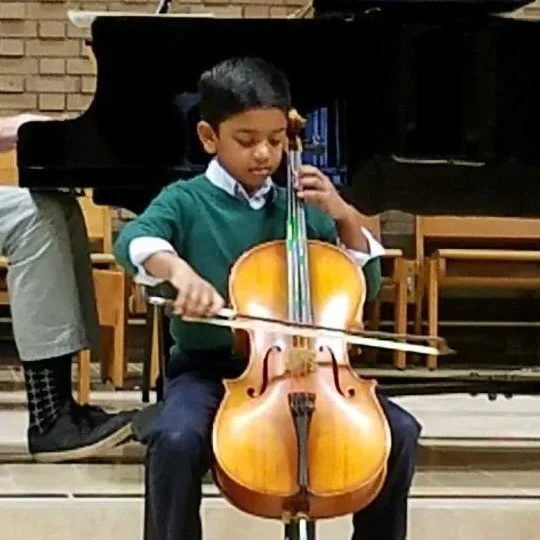
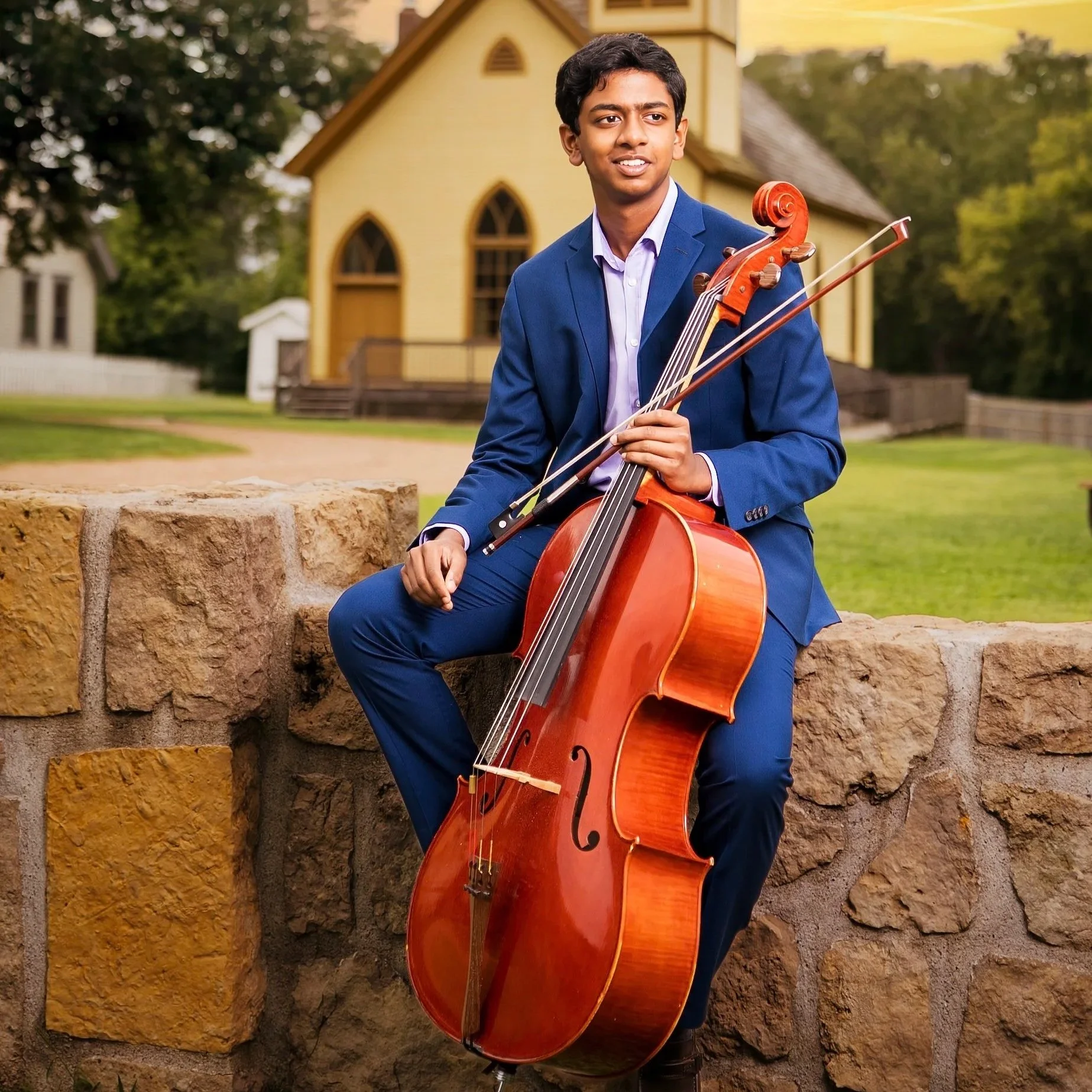
Aeon is an 11th grade cellist in the MYS Symphony Orchestra. He attends Stanford Online High School and studies cello with Dr. David Holmes.
Like many musicians who have the privilege of performing at Carnegie Hall, Aeon counts his debut at the iconic venue as among his most exhilarating musical experiences. That opportunity came at age ten, when he performed as a winner of the American Protégé International Piano and Strings Competition. But having all eyes on him on this storied stage didn’t faze him much. “Just your average audience,” he recalls. “I couldn’t really tell—I was busy paying attention to the music!” His ability to stay focused during big performances, whether as a soloist or in an orchestra, has developed over time. “You always have a little bit of nerves before every performance, but as you do more, you get used to that and it becomes something you can use.” It wasn’t always so easy. As a young child at summer music camp in Wisconsin, Aeon found the recitals to be quite nerve-racking. His parents and teachers gave him some simple advice: “They would tell me just to stare at my bow when I was playing and not worry about the audience.”
Aeon began playing cello at three and a half, with the Suzuki method’s component of family support playing an integral role in his musical development. One of his parents would attend each lesson and take notes, and his father even learned cello alongside him for the first five years. After joining MYS Philharmonic Orchestra in 2020, Aeon advanced to Repertory and then Symphony Orchestra, where he is now in his fifth year and the ensemble’s longest-standing member. Those years of experience have expanded his awareness beyond his own part and made him appreciate each player’s contributions. “I started paying more attention to other sections rather than whatever I’m playing. I’m looking up more,” he says. He’s learned to listen and respond to music unfolding around him, and he especially enjoys moments when the cello section exchanges musical ideas with other sections. As a soloist, he gravitates toward deeply emotional passages where he can stretch the phrase or fast, virtuosic showpieces. He recently performed Paganini’s Variations on One String on a Theme by Rossini, though he’s quick to point out that he hasn’t yet studied Paganini’s notoriously difficult 24 Caprices. “I still can’t do that!” he admits.
Looking up from his bow has helped Aeon see more of the musical world around him. His interest in what lies beyond his immediate surroundings extends well beyond the orchestra, too. A whale-watching trip at just two years old sparked his fascination with marine animals, but the pollution he witnessed also left a lasting impression. At seven, he founded Aeon for Ocean, a nonprofit dedicated to educating inland students about marine life and ocean conservation. Through the organization, he encourages young people in Minnesota—far from the coast—to understand why the oceans matter and how their own choices can help protect them. The connection between his environmental work and his musical life comes down to recognizing how individual contributions shape something larger. As Aeon puts it, “small things you do make a difference towards the bigger picture.”
For now, Aeon isn’t eager to map out every detail of that bigger picture. As an eleventh grader, he is beginning to set his sights on college. He is interested in pursuing a dual major in cello and biomedical science and hopes to keep playing cello after college, even if only as a hobby. But on one point, he is certain: his future lies near the ocean. “I can’t live inland for college,” he says, with Southern California at the top of his list. The young musician who once kept his eyes on his bow to manage has learned to look up, observe what’s around him, and draw connections with the wider world.