Carrying Forward a Family Legacy of Music
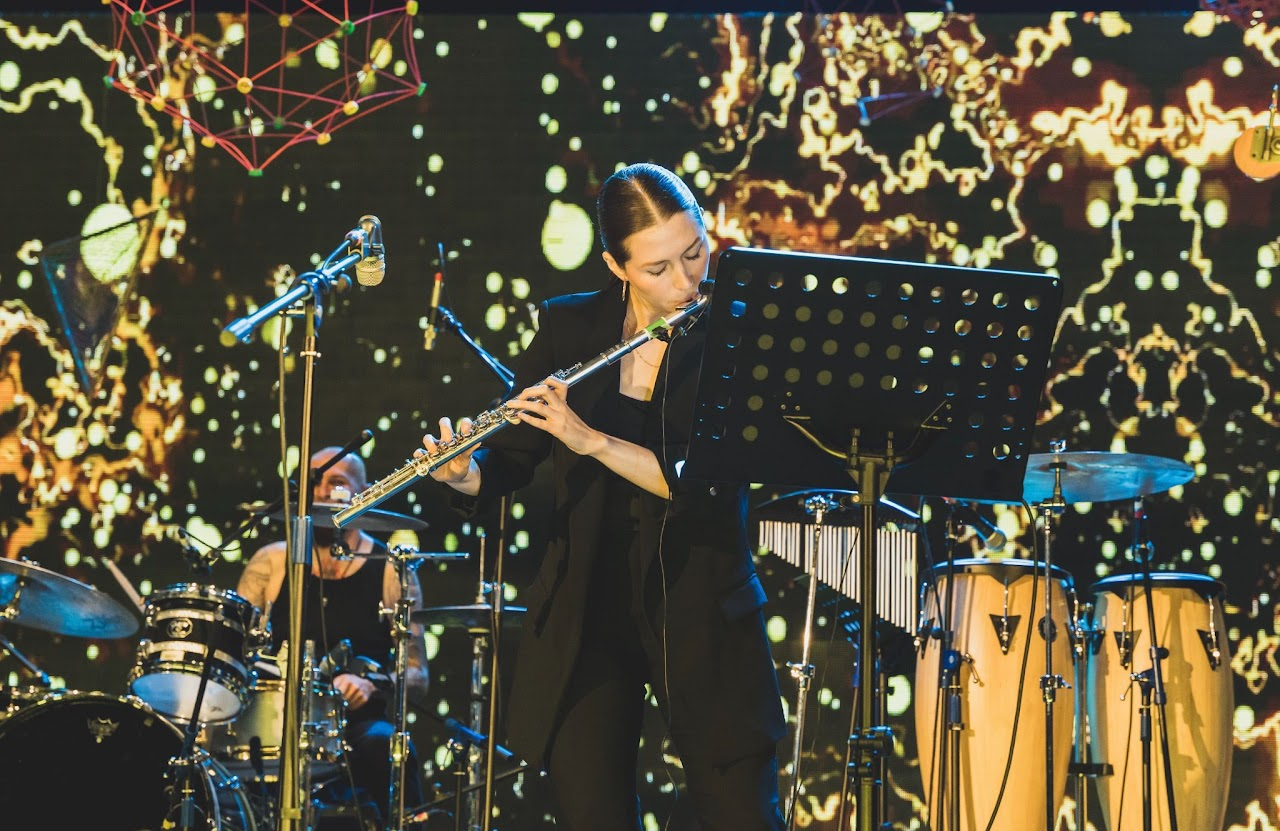
Claudia Aizaga is a member of the MYS Board of Directors and a flutist, teacher, and founder of SonAlt Arts.
When MYS Board Member Claudia Aizaga is performing, teaching, or collaborating, she brings more than just her expertise as a flutist; Claudia comes from a long line of musicians whose influence on classical music in Ecuador spans generations. Her paternal great-grandparents were both musicians and her grandfather, Claudio Aizaga, was a renowned composer, pianist, choral conductor, and scholar. After studying at the National Conservatory in Quito and later the Paris Conservatory, he became one of Ecuador’s pioneering composers, writing ballets and choral, chamber, and orchestral works that blended Western classical music with traditional Ecuadorian folk rhythms and styles. Together with his wife Giovanna, a pianist and music theorist, Claudia’s grandparents taught many of the musicians who would later become the country’s leading performers and educators.
Not surprisingly, music surrounded Claudia from an early age. Her father, Felipe Aizaga, was a professional violist, and many family members have been involved in the founding and operations of the youth orchestra program La Fundación Orquesta Sinfónica Juvenil del Ecuador (FOSJE). “I grew up listening to music all the time,” Claudia recalls. “I grew up going to concerts.” So it was only natural that she would study music as well, beginning flute lessons at age seven with her aunt Eugenia, a flutist with the National Symphony of Ecuador and founder of Ecuador’s Suzuki School. In the Aizaga family, music was valued not only as an art form, but also as a way to support education, cultural connection, and service to the community.
Since its founding in 1995, FOSJE has become one of Ecuador’s most important youth music organizations. Inspired by Venezuela’s El Sistema movement, FOSJE provides children with access to instruments, lessons, and orchestral training regardless of their financial circumstances. Claudia describes the organization as life-changing for many young musicians across the country. One of its most unique programs is the Orquesta de Papel, or “Paper Orchestra,” designed for students at the beginning of their musical journey. Together with their parents, students build scale models of their instruments out of cardboard in order to learn the basics of ensemble playing—walking onstage, tuning, playing together, and experiencing how an orchestra functions. To “perform” on their cardboard instruments, students sing their parts, developing ear training, ensemble skills, and confidence to prepare for their first real orchestra.
When Claudia joined youth orchestra at thirteen, her perspective on music changed completely. For the first time, she experienced the power of creating music as part of something larger than herself. She remembers feeling both excited and deeply responsible while performing major orchestral works at a high level. In Ecuador, access to an instrument and formal music education was considered an extraordinary privilege, and students took rehearsals seriously because they understood what the opportunity meant. The orchestra rehearsed for several hours multiple times a week—and sometimes daily when preparing for visits from conductors or guest artists from Venezuela’s El Sistema. “When you don’t have opportunities and somebody gives you an instrument,” Claudia says, “you have to do your best.” For Ecuador’s young musicians, their achievements represented not only artistic growth, but identity, purpose, and collective pride.
By age sixteen, Claudia had already begun teaching flute lessons herself, continuing the family tradition of mentorship and education. She built a large flute studio while also helping her brother Felipe, a violinist and now professor at the National Conservatory, form and direct a new orchestra at FOSJE. One of the most impactful teaching experiences for Claudia was a partnership between FOSJE and rural orphanages. Every Saturday, children from impoverished villages would board buses as early as 4:00 a.m. to travel to the capital for music instruction. Claudia remembers the extraordinary focus and dedication of those students, despite the obstacles they faced. Within only a few years many were performing advanced solo and orchestral repertoire, and several later became professional musicians themselves. Teaching those students strengthened Claudia’s belief that music education can truly transform lives—as it has hers.
Like many musicians in her family before her, Claudia eventually left Ecuador to continue her education abroad. At eighteen, she began studies at the University of Northern Iowa in the flute studio of Dr. Angeleita Floyd, whom Claudia had the good fortune of meeting at the Festival Internacional de Flautistas. Claudia’s early training centered largely on classical solo and orchestral repertoire, but graduate school at Louisiana State University opened her eyes to the world of contemporary and electroacoustic music. She especially remembers a semester in which her flute professor, Katherine Kemler, spent months analyzing just three contemporary flute works in detail. Claudia was fascinated with the way each composer created a unique musical language that performers must interpret through research, experimentation, and collaboration. “It’s not something you can just sightread,” she says. “You really have to study it.”
That experience led Claudia to pursue a doctoral degree in Contemporary Music at Bowling Green State University. Her collaborations with living composers during that program inspired her newest project: SonAlt Arts, a US-based non-profit organization. Their first big project is a festival launching in Ecuador this July. The SonAlt Arts Festival will connect Ecuadorian music students with composers and contemporary musicians from around the world, creating opportunities for collaboration, cultural exchange, and creative exploration. Drawing from her Ecuadorian and family roots, and from the educational experiences she gained in the United States, Claudia hopes SonAlt Arts will continue the mission that has shaped her life and generations of musicians before her: empowering emerging artists, promoting cultural exchange, and helping musicians discover possibilities they never imagined.